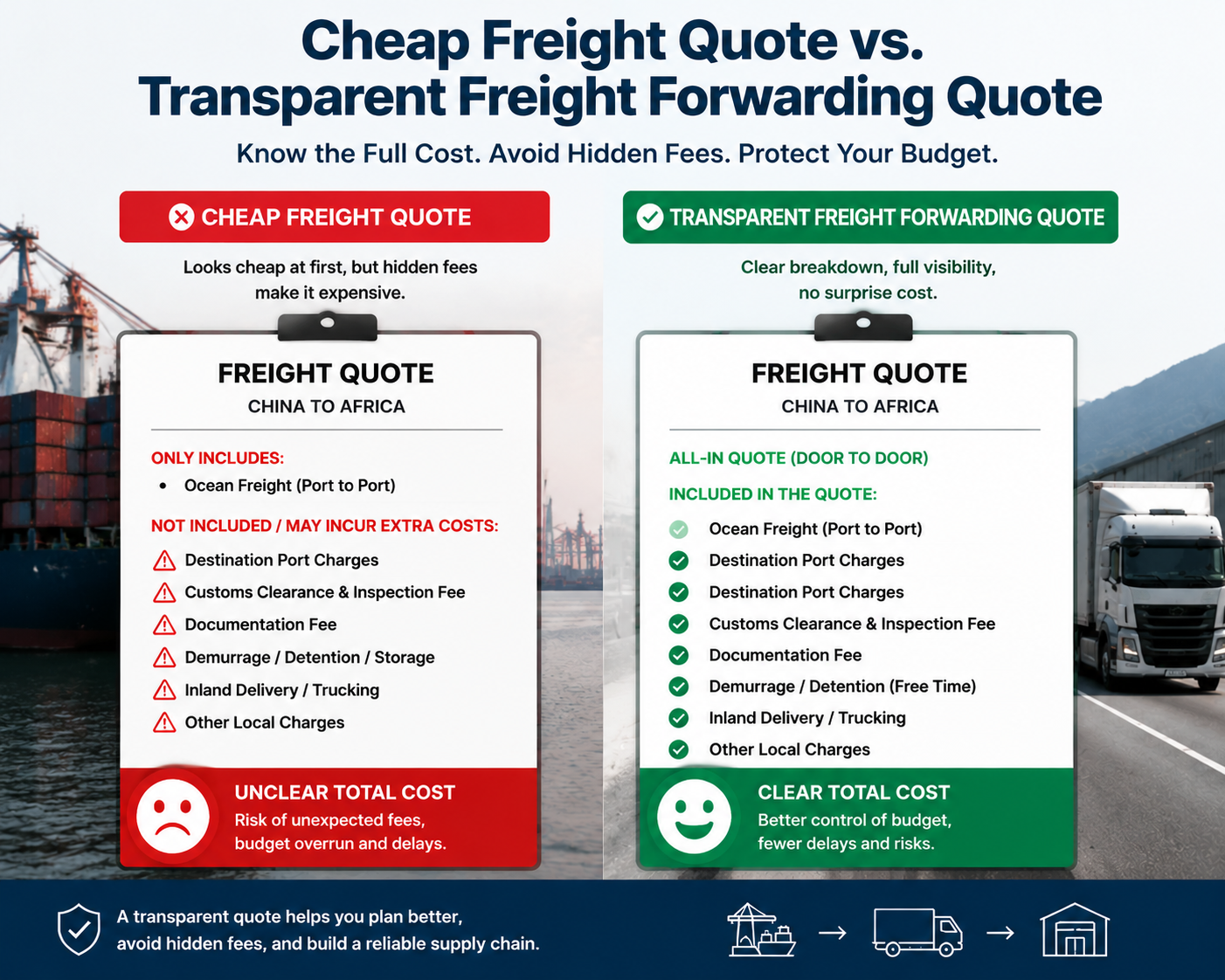
Are there any hidden fees besides the shipping cost?
Many importers shipping goods to Africa fall into the same trap: they receive an attractively low ocean freight quote, only to get unexpected extra bills once cargo arrives at the port. This article shows you the lines that can appear on an Africa-bound invoice, how each charge gets hidden, and how to spot them before you sign anything.
In this article
- Six charges that commonly stay hidden
- Where hidden charges hide
- Why “cheap” quotes end up costing more
- How to read a quote: 6 checks
- Pre-booking checklist: 10 items
- Frequently asked questions
- The bottom line
Six charges that commonly stay hidden
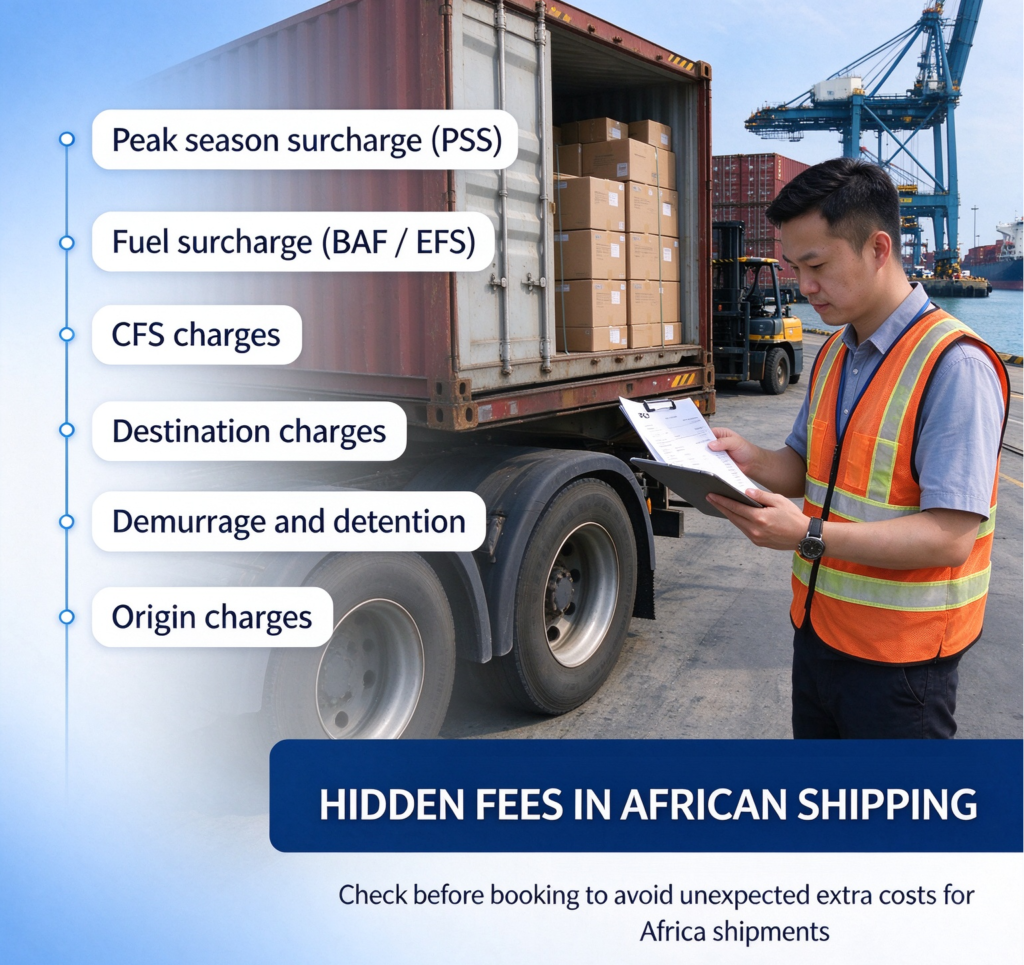
Each of these charges is legitimate. The issue is not that the charge exists; the issue is whether your quote discloses it before you commit. Each entry follows the same format: what it is, how it is hidden, and how you can bring it into view.
Peak season surcharge (PSS) — not on the quote, on the invoice
What it is. A surcharge carriers apply when demand rises and space becomes tight. It is published and legitimate.
How it gets hidden. It rarely appears on the first page of the quote. Once you book, it appears on your invoice marked “subject to market conditions”.
How to make it visible. Ask before booking: “Is PSS in effect now, and what is the rate this month?”
Fuel surcharge (BAF / EFS) — “included at quoting time, then changed”
What it is. A line item that moves with fuel prices; it can go up or down.
How it gets hidden. Quoted when fuel is low, billed when fuel rises — explained with one line: “market movement”.
How to make it visible. Ask for fuel surcharge as a separate line item and ask how adjustments work.
CFS charges (LCL cargo) — hidden in fine print
What it is. Container freight station charges for LCL (less-than-container-load, shared-container shipment): stuffing at origin and de-stuffing at destination.
How it gets hidden. A low quote only shows “LCL ocean freight”. The CFS line lands at destination, charged per cubic meter, and can run from a few hundred to over a thousand USD for a small shipment.
How to make it visible. Ask before booking: “What is the CFS rate per cubic meter, and is it included in the freight?”
Destination charges — farthest from you, hardest to see
What it is. Terminal handling, customs clearance, port storage, and final delivery on the African side.
How it gets hidden. The origin forwarder says “we have an agent at destination”. The itemized destination invoice arrives only after cargo lands.
How to make it visible. Ask for a written estimate of destination charges before booking, and confirm who handles clearance.
Demurrage and detention — no one tells you the free time
What it is. Charges for keeping the container too long: demurrage at the terminal, detention after gate-out. Ports in West Africa are often congested, free time is short, and charges accrue daily.
How it gets hidden. Quotes rarely state the free time. The container sits, days add up, and the invoice arrives without warning.
How to make it visible. Ask in writing before booking: “How many free days, and what is the daily rate after that?”
Origin charges — the vague “extras” line
What it is. Trucking to port, customs declaration, documentation, terminal handling on the Chinese side.
How it gets hidden. Buried in a line marked “miscellaneous” or “extras”. Trucking alone can vary widely by port for the same delivery address.
How to make it visible. Ask for each origin charge as a separate line item, and confirm which port and warehouse the quote covers.
Where hidden charges hide
Extra charges do not come from nowhere. They live in five predictable places:
- The cheap front page.A low freight number is a marketing tool. The shortfall gets recovered in line items no one asked to see.
- Vague scope.“All-in” with no list of what is included. If a quote cannot enumerate its components, it is not truly all-in.
- Conditions left out.Surcharges, currency adjustments and destination charges carry conditions — those conditions rarely appear on the quote.
- Port and terminal reality.Congestion, weekend storage, holiday schedules. Real-world events create real charges. A static quote cannot predict them; a responsible forwarder warns you upfront.
- Silent mismatch.Small errors in cargo description — wrong commodity, wrong weight, wrong container type — trigger re-inspection, fines or cargo hold, and the bill lands on the shipper.
Many low quotes are not outright fraud. They only list basic ocean freight without proactively disclosing surcharge risks, creating information gaps that leave importers responsible for unexpected expenses. A professional freight forwarder’s job is to lay out the costs and risks that can be identified upfront.
Why “cheap” quotes end up costing more
Here is a realistic hypothetical shipment scenario for cargo bound for Lagos (illustrative example, not a real client case).
Setup. An importer books a container with a low-priced forwarder. The quote: freight plus “a few extras”. No itemization.
What happens next.
- Booking confirms during peak season. A peak season surcharge appears on the invoice — a line not shown before booking.
- Part of the order is LCL. CFS charges land at destination per cubic meter, a cost the importer did not know would be invoiced separately.
- Vessel arrives late. Free time expires. Demurrage starts ticking day by day.
- Clearance delays because the cargo description does not match the goods. Corrections, re-inspection and storage days follow.
The tally. Small savings on ocean freight; charges discovered after booking are many times larger. The “cheap” quote becomes an expensive decision this quarter.
The lesson is not that most forwarders hide costs on purpose. The lesson is that a quote you cannot verify is not trustworthy — especially on a lane where schedule reliability is already a challenge.
How to read a quote: 6 checks
Run any quote through all six checks before comparing. A quote that fails any check is not comparable; it is a headline number.
Check 1 — Is freight separated from surcharges?
Ask: “List ocean freight, any active PSS, and fuel surcharge as separate line items.” Two quotes both marked “all-in” may include completely different things.
Check 2 — Are origin charges itemized?
Trucking, customs declaration, terminal handling, documentation. Ask for each named line. If trucking looks too good to be true, confirm the port and whether the price is port-to-port or door-to-port.
Check 3 — Are destination charges explained?
Who handles clearance? What are the terminal and storage terms? What is the free time? Few importers ask about free time, yet it decides whether demurrage hits you.
Check 4 — What is NOT included?
Ask: “Which charges sit outside this quote, and under what conditions do they apply?” A forwarder who answers clearly gives you the full cost map.
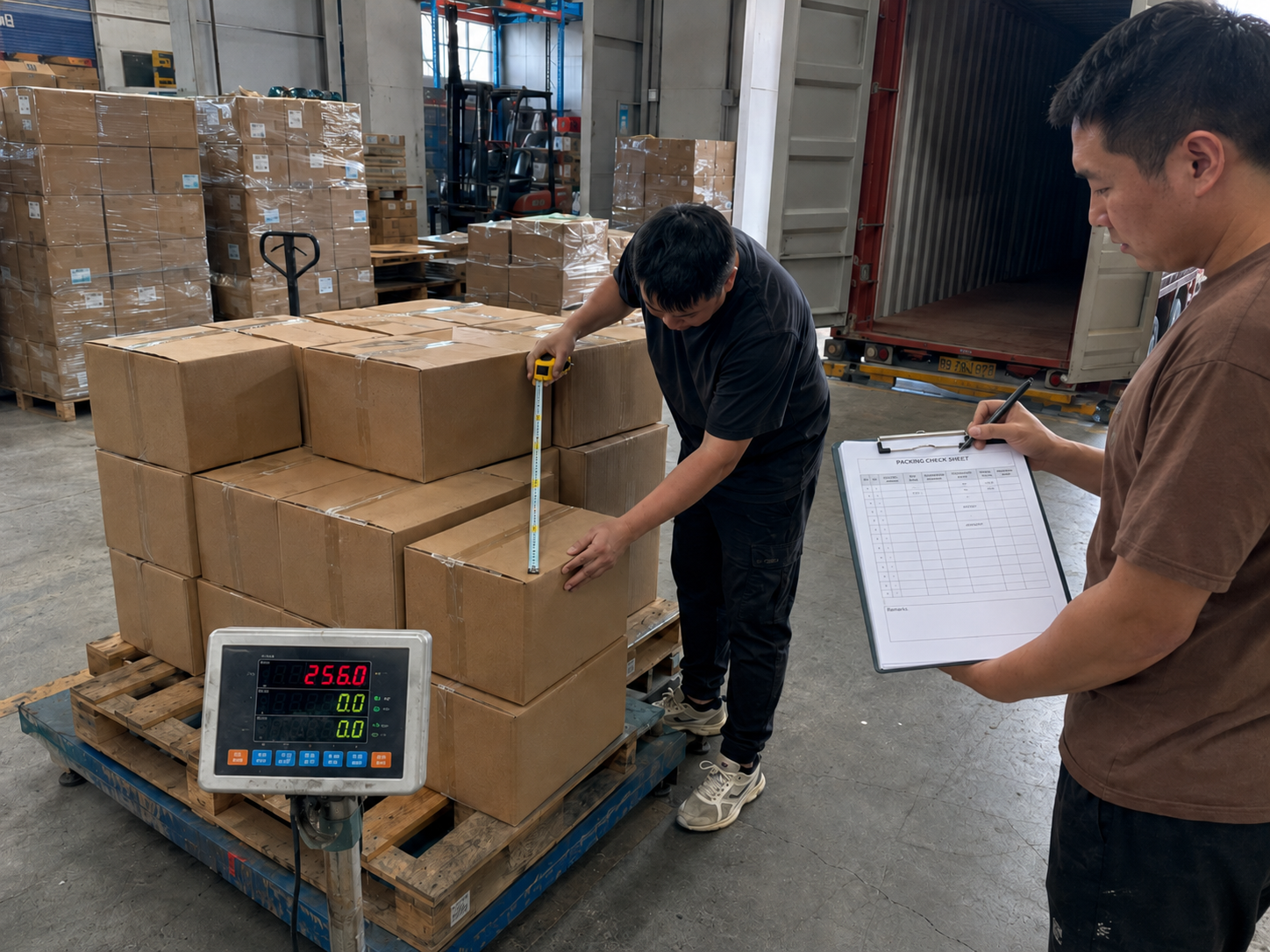
Check 5 — Is the cargo description accurate?
Wrong HS code (Harmonized commodity code) and wrong weight create avoidable destination trouble. Confirm commodity, weight, HS code, and container type. 40GP (general-purpose container) versus 40HQ (high-cube container) makes a real cost difference on many lanes.
Check 6 — Who owns the outcome?
When three parties touch the shipment — booking agent, destination agent, middleman — ask who takes responsibility when things go wrong. The reliable setup is one named contact owning the whole lane.
Pre-booking checklist: 10 items
Spend ten minutes before signing against this list; it saves importers thousands of dollars.
- Ocean freight shown as its own line item
- PSS / peak season surcharge: stated, with conditions (months and ports it applies to)
- BAF / EFS fuel surcharge: stated, with adjustment rules
- Origin trucking, declaration, THC, documentation: itemized
- Destination terminal handling and clearance: confirm who does it and the costs
- Free time at destination, plus daily demurrage/detention rates
- CFS rate per cbm at origin and destination (for LCL)
- Container type confirmed (40GP vs 40HQ) and why it matters for your cargo
- Cargo description, weight and commodity code verified accurate
- One named contact accountable for the whole shipment
If a forwarder hesitates on items 4–7, that is a signal. A professional will answer each point on this checklist.
Frequently asked questions
Q: What does “free time” mean and why does it matter?
Free time is the number of days you may use the container or leave it at the terminal before demurrage or detention starts. On Africa routes, free time tends to be short and ports often congested. Confirm free time in writing before booking; it directly sets your demurrage risk.
Q: Why is my invoice higher than the quote?
Almost always the quote covered only part of the cost: freight without surcharges, origin charges without destination charges, or “all-in” without defining what is included. Use the six checks above to surface gaps before you pay.
Q: What are CFS charges?
Container freight station charges: the cost to stuff and unstuff LCL cargo, invoiced separately at origin and destination per cubic meter. If your shipment is LCL and CFS is missing from the quote, ask before booking.
Q: Do you offer door-to-door shipping?
We offer port-to-port as our standard service. Door-to-door service works through pre-vetted local destination agents for clearance, warehousing and final delivery. Please note local customs requirements, port delays and third-party-agent risks remain subject to local market conditions. Confirm destination and cargo details and we will suggest the right service.
Q: How do I get a transparent quote?
Send your cargo details: origin, destination port, commodity, weight/volume, container type, expected shipping date. We return a one-page itemized quote: ocean freight, applicable surcharges, origin and destination charges separated, plus notes on items subject to change.
The bottom line
Hidden fees are not mysterious. They are simply fees not shown to you before you commit.
Three rules worth keeping:
- The cheapest quote is not a final price; it is an invitation to ask questions.
- The clearest quote is not marketing copy; it is your risk map for the shipment.
- The forwarder who answers “are there hidden fees?” with an itemized list and conditions for changes is the one who cares about your costs as much as you do.
About Okaytrans (Wanheng International Logistics)
We are Okaytrans (Wanheng International Logistics), based in Guangzhou, with 14 years of experience on the China-Africa lane.
Our core operating principles:
- Deliver one-page, fully itemized quotations
- Disclose cost factors subject to change upfront
- Decline cargo we cannot handle reliably
Get in touch
Choose the option that fits your needs:
- Free quote review: Already hold a freight quotation? Send it over for our no-obligation review. We outline what is included and flag potential hidden cost risks.
- Download the printable pre-booking checklist: Get our 10-point pre-booking checklist (email required).
- Request an itemized quotation: Submit your cargo details via the form below for a custom transparent quote.
[Contact Form]
Notes on accuracy
This article does not quote fixed ocean freight or port charges. China-Africa rates change weekly depending on commodity, destination port and booking terms.
Any specific number should come from a dated, confirmed written quote issued by your forwarder.
Industry reference ranges discussed in the article (CFS per cubic meter, daily detention fees) are for guidance only. Confirm current pricing in writing before booking.
Schedule reliability on Africa lanes consistently ranks lower than main trade lanes, and data changes monthly.
Even with a full written itemized quote, carrier-mandated rate changes, sudden local regulatory shifts, port strikes or force majeure events may create extra charges outside the forwarder’s control.
Disclaimer
This article is for general informational purposes only. Some shipment scenarios used are hypothetical, for education only. It is not a quotation, a contract, or customs or legal advice. Freight and port charges change at any time. Verify each amount in writing with your forwarder before booking. Each shipment differs, and applicable terms depend on your actual cargo, destination port and market conditions at booking time.
© 2026 Okaytrans / Wanheng International Logistics, Guangzhou, China.