A cheap freight quote may look good at first. But if it does not show the full cost, it can become expensive later. This guide explains why cheap freight quotes often lead to hidden fees, what charges importers should check before shipping,and how to ask for a transparent freight forwarding quote when shipping to Africa. You will learn how to compare quotes, avoid surprise costs, and choose a freight forwarder that helps protect your budget.
Why Cheap Freight Quotes Look Attractive at First
Many importers ask the same question: “Why did my final shipping cost become higher than the quote?”
The answer is often simple. The first quote did not include everything. Some freight quotes only show the main freight cost, such as ocean freight or air freight. This makes the price look low. But after the shipment starts, the buyer may see extra charges for customs clearance, destination port handling, document fees, storage, inspection, delivery, or local transport. This is why a cheap quote is not always the lowest total cost. A good quote should help you understand your full shipping cost before the cargo moves. According to the UNCTAD Review of Maritime Transport 2024, freight rates increased in 2024 because of rerouting, port congestion, and higher operating costs. This shows why a quote should also have a clear validity date and cost notes, not only a low number.
The Real Problem: Low Price, Unclear Scope
When you compare freight quotes, the most important question is not only: “How much is it?”
The better question is: “What is included, what is excluded, and what may change later?”
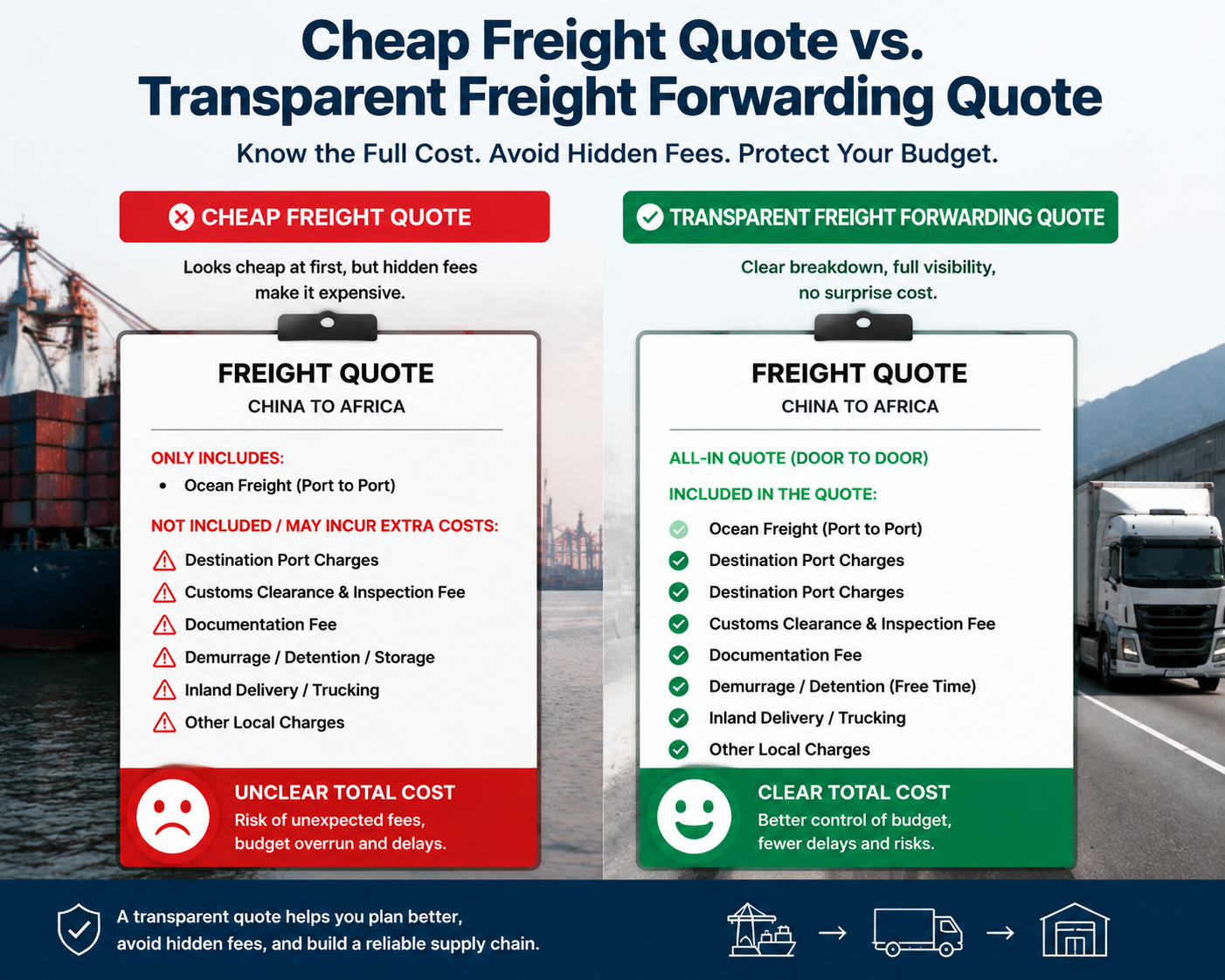
For example, two freight forwarders may quote the same shipment from China to Nigeria. One quote is lower, but it only includes port-to-port ocean freight. The other quote is higher, but it includes export handling, ocean freight, destination clearance support, and local delivery.
At first, the first quote looks cheaper. But after destination port fees, customs support, storage, and delivery are added, the final cost may be much higher.
A transparent freight forwarding quote should show the cost structure clearly. It should not hide important fees until the cargo reaches the destination.
Common Hidden Fees in Freight Forwarding
Hidden fees in freight forwarding are not always “fake” fees. Many are real logistics costs. The problem is that some quotes do not explain them early enough.
Here are the most common fees importers should check.
Destination Port Charges
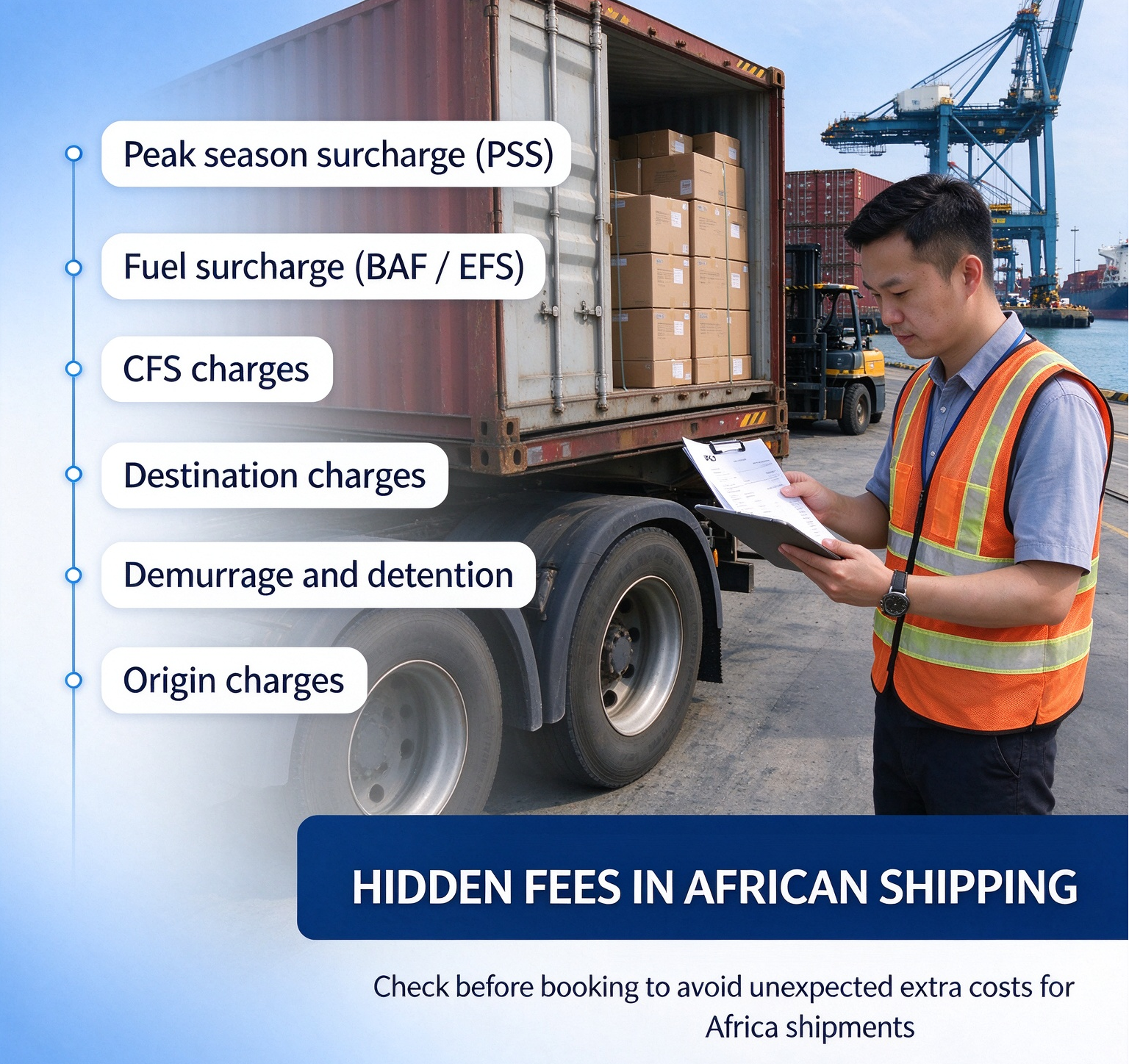
Destination port charges are one of the biggest sources of surprise costs. These may include terminal handling charges,document fees, delivery order fees, port security fees, and local agent fees.
If your quote only covers ocean freight to the destination port, these costs may still be paid by the consignee after arrival.
For Africa shipping, destination port charges can vary by country, port, carrier, shipment type, and local handling process. This is why you should ask your forwarder to list these costs before shipping.
Demurrage, Detention, and Storage
Demurrage, detention, and storage are common charges in container shipping.
DHL explains in its guide to demurrage, detention and storage charges that these charges are related to the use of containers, yards, freight stations, or warehouse space when cargo or
equipment is not moved within the allowed free time.
In simple words:
Demurrage may happen when the container stays at the port too long after arrival.
Detention may happen when the container is picked up but not returned in time.
Storage may happen when cargo takes up space in a port, yard, or warehouse longer than allowed. These costs can grow quickly if documents are late, customs clearance is delayed, or the consignee is not ready to receive the cargo.
Fuel, Peak Season, War Risk, and Currency Adjustment
Some surcharges may change because of market conditions. These can include fuel surcharge, peak season surcharge, war risk surcharge, emergency cost recovery, and currency adjustment.
This does not mean every quote will change. But a transparent quote should tell you which parts are fixed, which parts are estimated, and how long the quote is valid.
Why Africa Shipping Costs Are Easier to Misunderstand
Shipping to Africa often has more cost variables than simple port-to-port shipping.
One reason is that logistics performance differs by country and route. The World Bank Logistics Performance Index measures supply chain connectivity, speed, and reliability across countries. For importers, this means one Africa route may be smooth, while another route may need more planning.
Port and Customs Conditions Are Different
Each African country has its own port process, customs rules, document needs, and local handling style.
A shipment to Ghana may not have the same process as a shipment to Kenya, Nigeria, Tanzania, South Africa, or Angola.
Even within the same country, costs may change based on cargo type, container size, delivery address, and consignee readiness.
Cheap Quote vs Transparent Quote: What Is the Difference?
A cheap quote shows a price.
A transparent quote explains the price.
That is the key difference.
A low quote may only show one line: “Ocean freight: USD X.”
A transparent quote should show more details, such as:
Origin charges
Main freight
Destination charges
Customs clearance responsibility
Duties and taxes responsibility
Delivery cost Document fees
Possible inspection or storage risk
Quote validity date Service scope and Incoterms
The ICC Incoterms rules help define the obligations, costs, and risks of buyers and sellers under different trade terms. This matters because FOB, CIF, CFR, DAP, and DDP do not mean the same thing. If you compare two quotes with different Incoterms, you may compare the wrong costs.
What Should Be Included in a Transparent Freight Forwarding Quote?
A good quote should not make the buyer guess. It should clearly show what the freight forwarder is responsible for.
Here is what you should expect.
Cargo Details
The quote should be based on clear cargo information, including:
Product name
HS code if available
Gross weight
Volume
Number of packages
Package type
Cargo value
Battery, liquid, powder, magnetic, or dangerous goods status
If cargo details are wrong, the final cost may change.
Route and Service Type
A transparent quote should show the route clearly.
For example:
From supplier warehouse in Guangzhou to consignee warehouse in Lagos
From Shenzhen port to Tema port
From Shanghai airport to Nairobi airport
From Yiwu warehouse to door address in Accra
It should also show the service type, such as port-to-port, door-to-port, door-to-door, DAP, or DDP.
Full Cost Breakdown
A strong quote should break down the cost. It should not hide everything inside one total amount.
A cost breakdown helps you understand where your money goes. It also makes it easier to compare two forwarders fairly.
Included and Excluded Items
This part is very important.
A transparent freight forwarding quote should clearly say what is included and what is not included.
For example, it should tell you if customs duty, import VAT, inspection fee, storage, unloading, waiting time,or remote delivery is included or excluded.
A quote that clearly says “not included” is often better than a quote that stays silent.
Possible Extra Charges
Not every extra fee can be known before shipping. But a good forwarder should warn you about common risk charges.
For example:
Customs inspection
Late document fee
Wrong declaration amendment
Storage after free time
Demurrage or detention
Truck waiting time
Special unloading
Remote area delivery
This does not scare the buyer. It helps the buyer plan.
Real Example: How a Cheap Quote Becomes More Expensive
Let’s say an importer ships LCL cargo from Guangzhou, China to Lagos, Nigeria.
The cargo is 5 CBM of auto parts.
Forwarder A gives a very low quote. It only includes basic ocean freight to Lagos port. The buyer accepts it because the price looks cheaper.
After the cargo arrives, the buyer finds extra costs:
Destination handling charge
Delivery order fee
Customs clearance support fee
Warehouse storage
Local delivery from port to warehouse
Document amendment fee because the consignee information was incomplete
In this type of case, the final cost may become much higher than the first quote. Some importers find that missing destination charges, storage, and delivery costs can increase the real shipping budget by 25% to 35%, depending on the route, cargo type, and local process.
Forwarder B gives a higher quote at the beginning. But the quote lists destination handling, clearance support, local delivery, and possible storage risk before shipping.
In the end, Forwarder B is easier to plan with. The buyer can see the real landed cost earlier.
This is the main lesson: The cheapest quote is not always the best quote. The best quote is the one that helps you control the final cost.
Expert Insight from Okaytrans
Based on our Africa logistics experience, many cost problems happen because buyers compare two quotes without checking the service scope.
One quote may include only basic freight. Another quote may include more handling, clearance support, and delivery service.
So before you choose the cheaper price, compare these points:
Same cargo details
Same origin and destination
Same Incoterm
Same service type
Same included charges
Same destination cost responsibility
Same delivery address
Same quote validity
Only then can you compare the price fairly.
A transparent quote protects your budget because it gives you the full picture before the shipment starts.
How to Check If a Freight Quote Has Hidden Fees
Before you accept a quote, ask these questions.
1. Is This Port-to-Port or Door-to-Door?
Do not assume the quote includes delivery. Ask if the service ends at the destination port, airport, warehouse, or your final door address.
2. Are Destination Charges Included?
Ask for destination port charges before shipping. This is very important for Africa imports.
3. Who Handles Customs Clearance?
Ask if the forwarder handles customs clearance, supports the consignee, or only provides shipping to port.
4. Are Duties and Taxes Included?
In many cases, import duty and tax are not included unless the service is DDP or another agreed door-to-door tax-included solution.
5. What Fees May Change Later?
Ask about fuel, carrier surcharge, inspection, storage, demurrage, detention, and truck waiting time.
6. How Long Is the Quote Valid?
Freight rates can change. A transparent quote should show a validity date.
7. What Documents Do I Need to Prepare?
Late or wrong documents can lead to customs delays and extra fees. Ask for the required document list before shipment starts.
How Okaytrans Helps You Avoid Hidden Freight Costs
Okaytrans focuses on shipping from China to Africa. We understand that importers do not only need a low price. They need a clear cost plan.
Our goal is to help you understand your shipping cost before the cargo moves.
With Okaytrans, you can request:
A clear cost breakdown
Port-to-port, door-to-door, or DDP options
Africa destination handling support
Customs clearance coordination
Local delivery cost checking
Risk reminders before shipment
Clear notes on included and excluded charges
We do not believe in winning trust with a low number and surprising the customer later. We believe a good logistics partner should help you see the real cost early.
If you are tired of cheap quotes that become expensive at the end, Okaytrans can help you get a more transparent freight forwarding quote for your next Africa shipment.
Conclusion: A Transparent Quote Is Better Than a Cheap Surprise
A cheap freight quote may save money at first glance, but it can cost more if important fees are missing. For Africa shipping, importers should pay close attention to destination charges, customs clearance, inland delivery, demurrage, detention, storage, and quote validity.
The best way to avoid hidden shipping costs is to ask for a transparent freight forwarding quote . It should show what is included, what is not included, and what may change later.
When you understand the full cost before shipping, you can protect your budget, avoid delays, and make better import decisions.
FAQ About Hidden Fees in Freight Forwarding
Why is my final shipping cost higher than the original quote?
Your final shipping cost may be higher because the original quote did not include destination charges, customs clearance, inspection fees, storage, demurrage, detention, inland delivery, or other local costs. Always ask for a full cost breakdown before shipping.
What hidden fees should I check before shipping to Africa?
You should check destination port charges, customs clearance fees, document fees, inspection fees, storage, demurrage, detention, fuel surcharge, local delivery, and truck waiting time. These costs can change your final landed cost.
Is the cheapest freight quote always the best choice?
No. The cheapest freight quote may only include part of the service. A transparent quote is often better because it shows the full cost structure and helps you avoid surprise fees later.
How can I avoid hidden shipping costs?
Ask your freight forwarder for a detailed quote. Confirm the Incoterm, service scope, destination charges, customs responsibility, delivery address, quote validity, and possible extra charges before the shipment starts.
Can Okaytrans provide a freight quote with no hidden fees?
Okaytrans can provide a clear and itemized Africa shipping quote. We explain included costs, excluded costs, and possible risk charges before shipping, so you can plan your budget with more confidence.