The impact of the Middle East war on ocean freight forwarding to Africa is now a real planning issue for importers,exporters, and supply chain teams. This article explains how the conflict is affecting freight rates, transit time,routing decisions, and delivery reliability for Africa-bound cargo. You will also learn what shippers can do right now to reduce risk and how to choose a freight forwarder that can still build a workable plan in a volatile market.According to the UNCTAD Review of Maritime Transport 2025, shipping networks continue to operate in a more uncertain environment shaped by longer routes, higher costs, and
disrupted schedules.
How the Middle East War Is Changing Ocean Freight to Africa
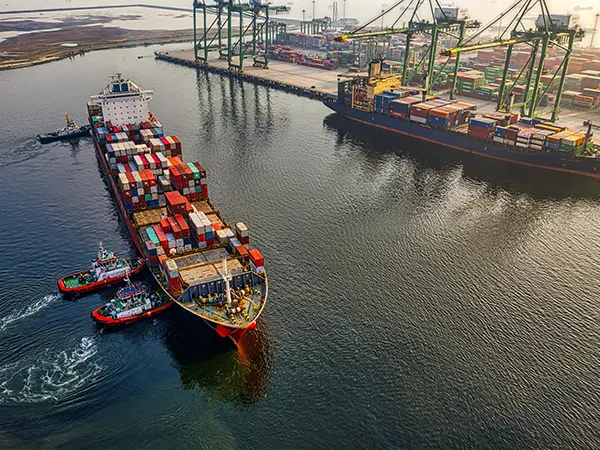
For many businesses, the biggest problem is not the conflict itself. The real issue is what it does to cargo planning.When security risk rises in or near the Red Sea, carriers may reduce or suspend transits through the Bab el-Mandeb and Suez corridor and reroute vessels around the Cape of Good Hope. That change affects sailing distance, vessel rotation,equipment circulation, and delivery planning across multiple trade lanes. UNCTAD’s 2025 review notes that the Suez Canal has been operating far below earlier transit levels, showing that the disruption has had a lasting effect on maritime networks.
For Africa-bound cargo, the effect can be even more visible because many shipments depend on feeder services,transshipment hubs, and tight handoffs between mainline and regional connections. If the upstream route becomes unstable, importers may face rolled cargo, changed ETAs, missed connections, and higher storage or demurrage exposure at destination.
Why the Middle East War Affects Ocean Freight Forwarding
Ocean freight forwarding depends on route stability. A freight forwarder does not only book vessel space. A forwarder also aligns the sailing plan, cut-off timing, port pair, transshipment route, documentation flow, customs timing, and final delivery coordination. When conflict affects a key trade corridor, all of these moving parts become harder to control.
The World Bank’s analysis of the Red Sea shipping crisis describes the crisis as a major disruption to trade and maritime transport, while the IMO Red Sea area updates continue to track conflict-related attacks and safety information for ships, cargoes, and seafarers. That is why this topic is not just about geopolitics. It is a direct operating risk for cargo owners, carriers, ports, insurers, and freight forwarders.
A good freight forwarder usually feels the disruption early. First, carriers change network plans.Then rate validity becomes shorter. Then vessel schedules become harder to trust. Finally, downstream cost and delay pressure appear in the quote, the ETA, or both. This is why a confirmed booking does not always mean a stable shipping plan in a security-driven market.
How the War Impacts Ocean Freight Rates to Africa
Freight rates tend to rise during a regional shipping crisis for several reasons. Longer sailing distance increases fuel and operating cost. Rerouting keeps vessels busy for more time, which puts pressure on available capacity and container circulation. Security-related pricing, emergency surcharges, and planning inefficiencies may also push up the final cost of shipping. The World Bank notes that the Red Sea crisis has increased freight and insurance costs, while UNCTAD has warned that volatility and uncertainty remain major features of the shipping market.
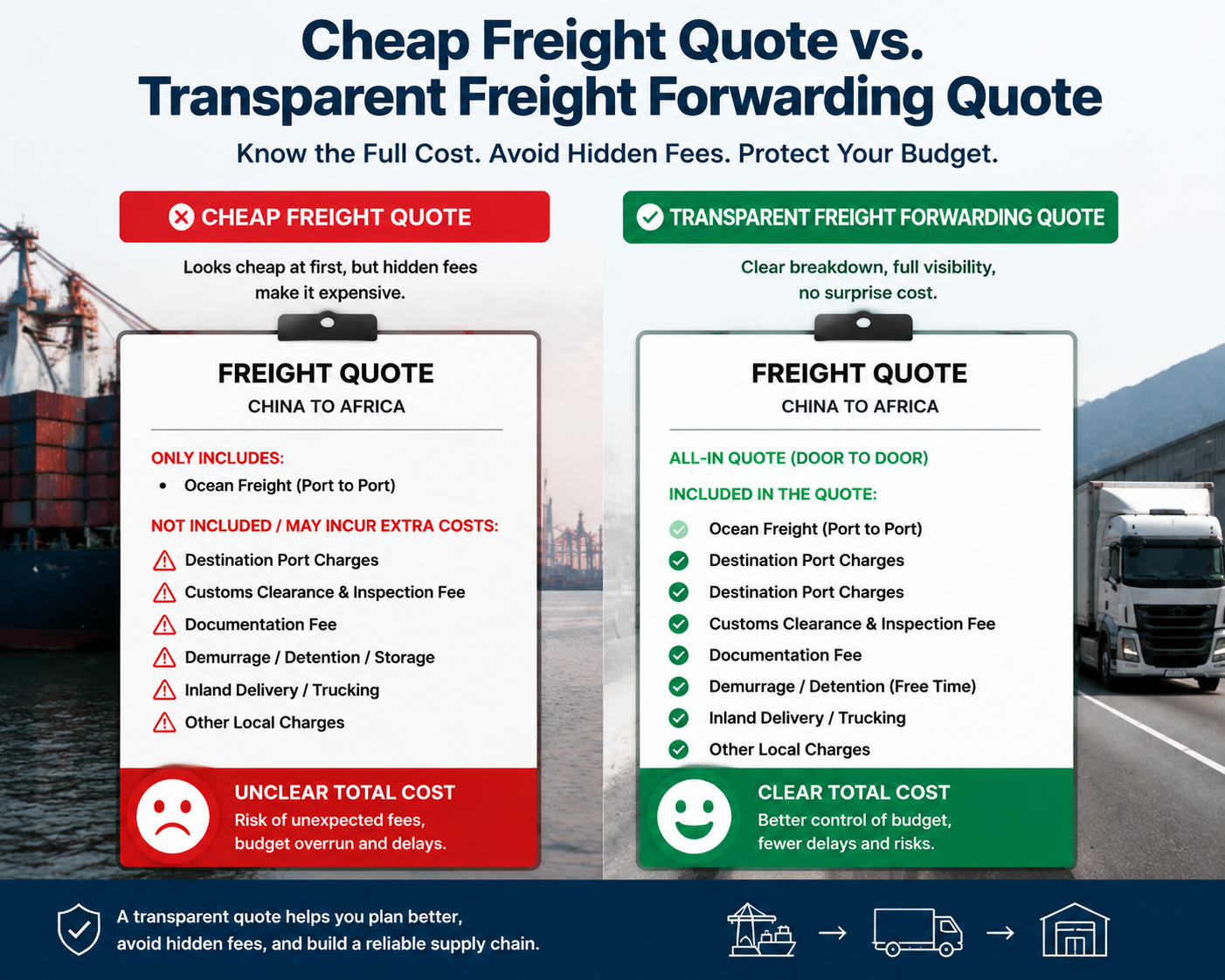
For Africa shippers, the real problem is often not just the ocean rate itself. It is the total logistics cost. A shipment may start with a higher freight quote, then become more expensive because of later cut-off dates, route changes, extra storage, delayed customs handling, or missed delivery windows. That is why shippers should ask for a cost breakdown rather than looking only at one headline rate.
In practice, there are three cost areas worth watching closely.
1. Base freight movement
If a carrier’s service network becomes longer and less efficient, the freight base may rise quickly. This is especially true when route assumptions change at short notice. On March 1, 2026,Maersk announced the rerouting of ME11 and MECL services around the Cape of Good Hope because of escalating Middle East security risks and a pause in future Trans-Suez sailings for those services.
2. Risk and disruption charges
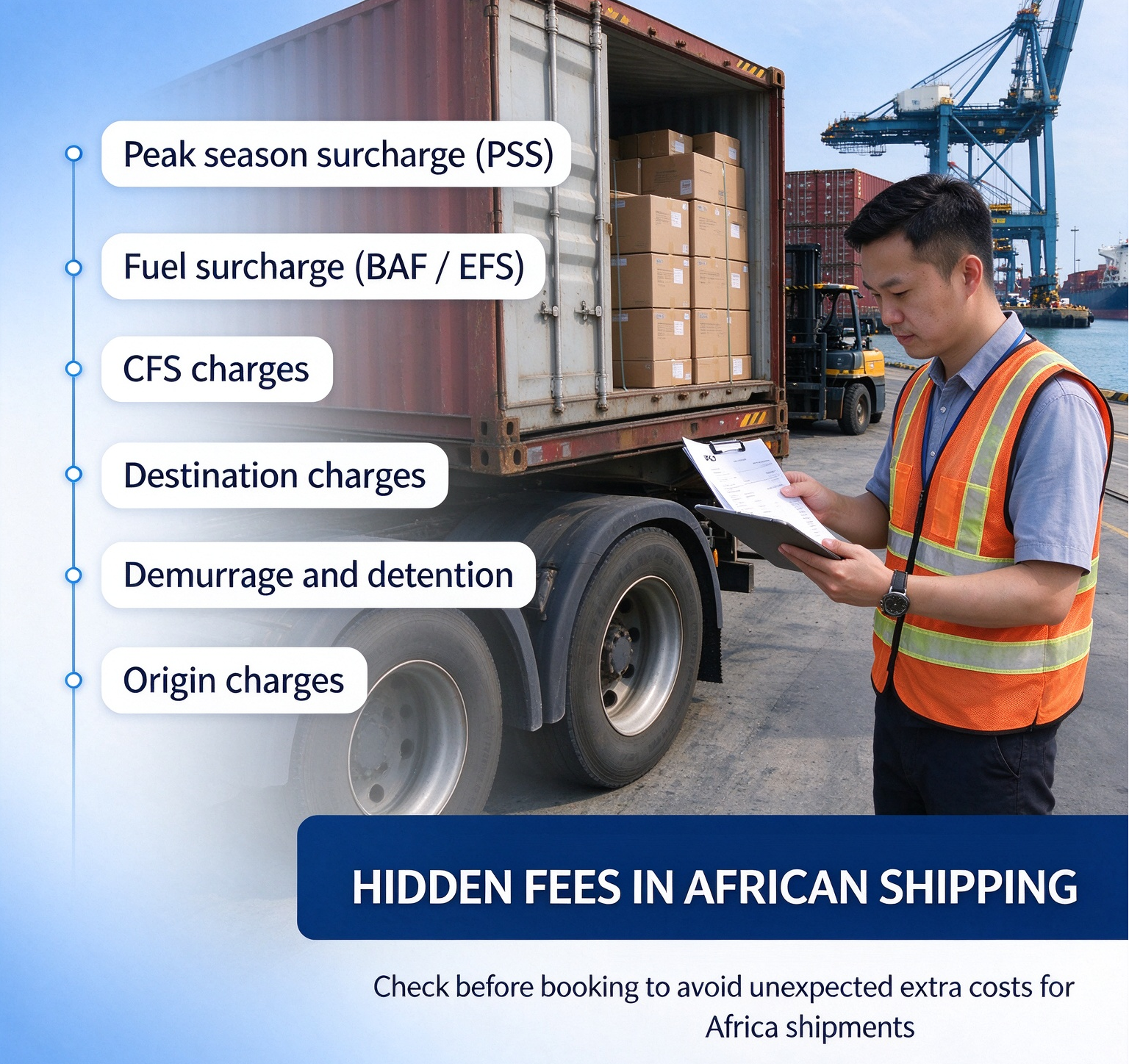
These may include war-related charges, security surcharges, equipment imbalance costs, and other crisis-related operating add-ons. The exact structure depends on the carrier, the route, and the timing of booking.
3. Delay-driven indirect cost
This is the hidden cost many shippers underestimate. If cargo arrives late, the business may spend more on emergency replenishment, idle inventory planning, missed sales, project delay, or contract penalties than on the freight increase itself.
How Transit Time and Schedule Reliability Are Being Affected
Transit time is no longer just about days at sea. In the current market, shippers need to look at the full chain: vessel departure, route selection, transshipment handoff, port congestion, discharge timing, and inland delivery planning.
When carriers reroute around the Cape of Good Hope, sailing distance increases and schedules often need to be rebuilt. That means a quoted transit time can become outdated quickly if the security environment changes. Maersk’s March 2026 customer advisory is a strong reminder that route stability in this corridor still depends on real-time risk assessment rather than fixed assumptions.
For Africa-bound cargo, schedule reliability matters just as much as total transit time.Many African trade lanes depend on one or more transshipment hubs. If the mother vessel arrives late, the feeder connection may be missed, and that creates a second delay after the main ocean leg. So the real planning question is not “What is the shortest transit time?” It is “How likely is this route to stay on plan?”
A practical way to plan in this market is to ask your freight forwarder for three ETA scenarios:
best-case ETA
working ETA
risk-case ETA
That simple change can improve purchasing decisions, warehouse planning, and customer communication.
For a visual update on how security events continue to affect major shipping routes, you can also reference the latest industry and carrier advisories alongside the IMO Red Sea area updates.
Which Africa Trade Lanes and Cargo Types Are Most Exposed
Not every Africa shipment faces the same level of risk.
In general, cargo becomes more exposed when it depends on Red Sea or Suez-linked routing, multiple transshipment steps, limited inventory buffer, strict delivery deadlines, or only one realistic carrier option. East Africa, North Africa, and transshipment-heavy services often need especially careful review because a small upstream schedule change can damage the final handoff. That does not mean West Africa is untouched. It simply means the disruption may appear in a different way, such as rolled cargo, unstable feeder timing,or wider freight rate fluctuation.
Some cargo types are more vulnerable than others.
Time-sensitive cargo
Retail replenishment, project-linked materials, and factory input cargo can become expensive very quickly when delivery slips beyond the expected window.
High-value cargo
Higher-value goods usually carry greater exposure to delay, handling risk, and insurance sensitivity.
LCL cargo
LCL shipments often involve more handling steps through consolidation and deconsolidation, which can increase the chance of timing disruption in an unstable market.
Project cargo support shipments
If a shipment is tied to crane windows, contractor schedules, or site readiness, even a modest delay can affect much more than transport cost alone.
Example:A China-to-East Africa shipment originally planned on a Red Sea-linked service had to be adjusted after a carrier network change. By moving the cargo to a more stable alternative routing and adding extra lead-time buffer, the shipper reduced the risk of missing a project delivery milestone, even though the freight cost was slightly higher. This is often the trade-off in the current market: lower risk may matter more than the cheapest initial quote. A forwarder with real Africa experience should be able to explain not only whether a route is open, but also how stable the handoffs are, how many workable options exist, and where the weak points sit in the chain.
What Shippers Can Do to Reduce Risk Right Now
Shippers cannot control geopolitics, but they can control how they plan around it.
Build more buffer into lead time
Booking too close to the cargo-ready date is much riskier when route assumptions can change fast. Give more time to procurement, booking, vessel selection, and delivery planning.
Review route options before booking
Do not accept only one route suggestion. Ask whether your cargo has: a direct route option a more stable transshipment option an alternative discharge port option a split-shipment option for urgent cargo
Ask for a real quote, not just a low quote
A useful quotation should explain rate validity, likely surcharges, route assumptions, and what may trigger a change.
Plan by cargo priority
Not every shipment needs the same service level. Separate urgent cargo from routine cargo. One part may need the fastest reliable route, while the rest can move on a lower-cost plan.
Build a backup plan
The shipping industry continues to treat voyage security and dynamic risk planning as a serious issue. In 2025, major industry associations launched the consolidated BMP Maritime Security guidance , designed to provide more actionable security protocols and updated risk management support for ships operating in volatile environments.
Forwarder’s note: In a disrupted market, the cheapest route is not always the lowest-cost option. A route with fewer handoffs and more reliable schedule logic may reduce the total risk cost for Africa-bound cargo.
A simple risk checklist for Africa-bound shippers:
What route is being used right now?
Is it direct or transshipment-based?
How long is the rate valid? What extra charges are most likely?
What is the fallback plan if the vessel is rerouted?
What ETA should the sales and procurement teams use internally?
How to Choose a Freight Forwarder During a Shipping Crisis
A weak freight forwarder talks only about price. A strong freight forwarder explains the route, the risk, and the plan.
During a shipping crisis, the right logistics partner should be able to do five things well.
1. Explain routing clearly
They should tell you whether the cargo will move direct, transship, or change port if needed.
2. Show schedule logic
They should explain not only when the vessel departs, but also how reliable the handoff is for the final Africa destination.
3. Break down charges
They should show which part of the quote is base freight, which part is risk-related, and which costs may still change.
4. Offer alternatives
A capable forwarder should present more than one workable option.
5. Understand destination realities in Africa
This matters more than many shippers think. Local experience can help with customs timing, document readiness, port-specific handling issues, and last-mile coordination after discharge.
This is where specialized Africa logistics support becomes more valuable. In uncertain times, practical routing knowledge and local destination experience often matter more than a low opening quote.
How Okaytrans Can Help
At Okaytrans, we support Africa-bound cargo with practical freight planning, not just space booking. We help shippers review route options, compare transit risk, explain surcharge exposure, and build safer shipping plans for FCL, LCL, and project cargo.
If your cargo may be exposed to Red Sea or Middle East disruption risk, our team can help you:
review the most workable routing option
estimate a more realistic transit window
compare cost versus route stability
prepare a backup shipping plan for urgent orders
Conclusion
The impact of the Middle East war on ocean freight forwarding to Africa is real, and it shows up in four clear ways:higher costs, longer or less reliable transit time, greater route uncertainty, and more complex planning decisions. The answer for shippers is not to stop moving cargo. The answer is to plan earlier, build more buffer, and work with a freight forwarder that can explain both the route and the risk. As long as Red Sea security remains unstable and major carriers continue to adjust service patterns, Africa-bound supply chains will benefit from flexible routing, clearer cost control, and stronger contingency planning. Recent carrier actions, including Maersk’s rerouting of ME11 and MECL around the Cape of Good Hope, show that these planning decisions are still highly relevant.
FAQ: Impact of the Middle East War on Ocean Freight Forwarding
Is the Middle East war still affecting ocean freight to Africa?
Yes. The impact is still visible in routing decisions, transit reliability, and freight planning. The UNCTAD Review of Maritime Transport 2025 shows that the Suez Canal has continued to operate well below earlier transit levels, and recent carrier advisories confirm that security conditions can still force route changes.
Why are shipping rates to Africa rising during the conflict?
Shipping rates can rise because vessels take longer routes, capacity stays tied up for longer periods, insurance and security costs increase, and schedule disruption creates extra operating pressure. The World Bank’s Red Sea shipping crisis analysis highlights both freight and insurance pressure during the crisis.
Will my shipment be delayed if the vessel avoids the Red Sea?
Not always, but the risk usually increases. The longer route itself adds sailing time, and the larger problem is often the knock-on effect on transshipment, feeder timing, and final delivery planning. That is why it is safer to ask for multiple ETA scenarios instead of relying on one ideal arrival date.
What kind of cargo is most likely to face delay or extra cost right now?
Time-sensitive cargo, LCL shipments, project-linked cargo, and higher-value goods are often the most exposed. These shipments are more sensitive to missed connections, repeated handling, and delivery delays.
How can I reduce freight risk when shipping to Africa now?
Book earlier, ask for more than one route option, separate urgent cargo from standard cargo, request a full cost breakdown, and create a backup plan before booking. A freight forwarder with strong Africa experience can often reduce risk by matching the right route to the right cargo priority.